 ← Back to FSPI 101FSPI Core 101 Insights
How the Index Works
2 min read
From Stats to a Single Number
A sports performance index takes dozens of statistics and distills them into one number. Let's walk through an example from the 2025-26 regular season, where the Chicago Blackhawks traveled to play the St. Louis Blues, seen from the viewpoint of the CME FSPI NHL Chicago Blackhawks Index (ticker: NHLCHI). The index levels in this example are simulated from official statistics for illustration, since the indexes were not live during the 2025-26 season.
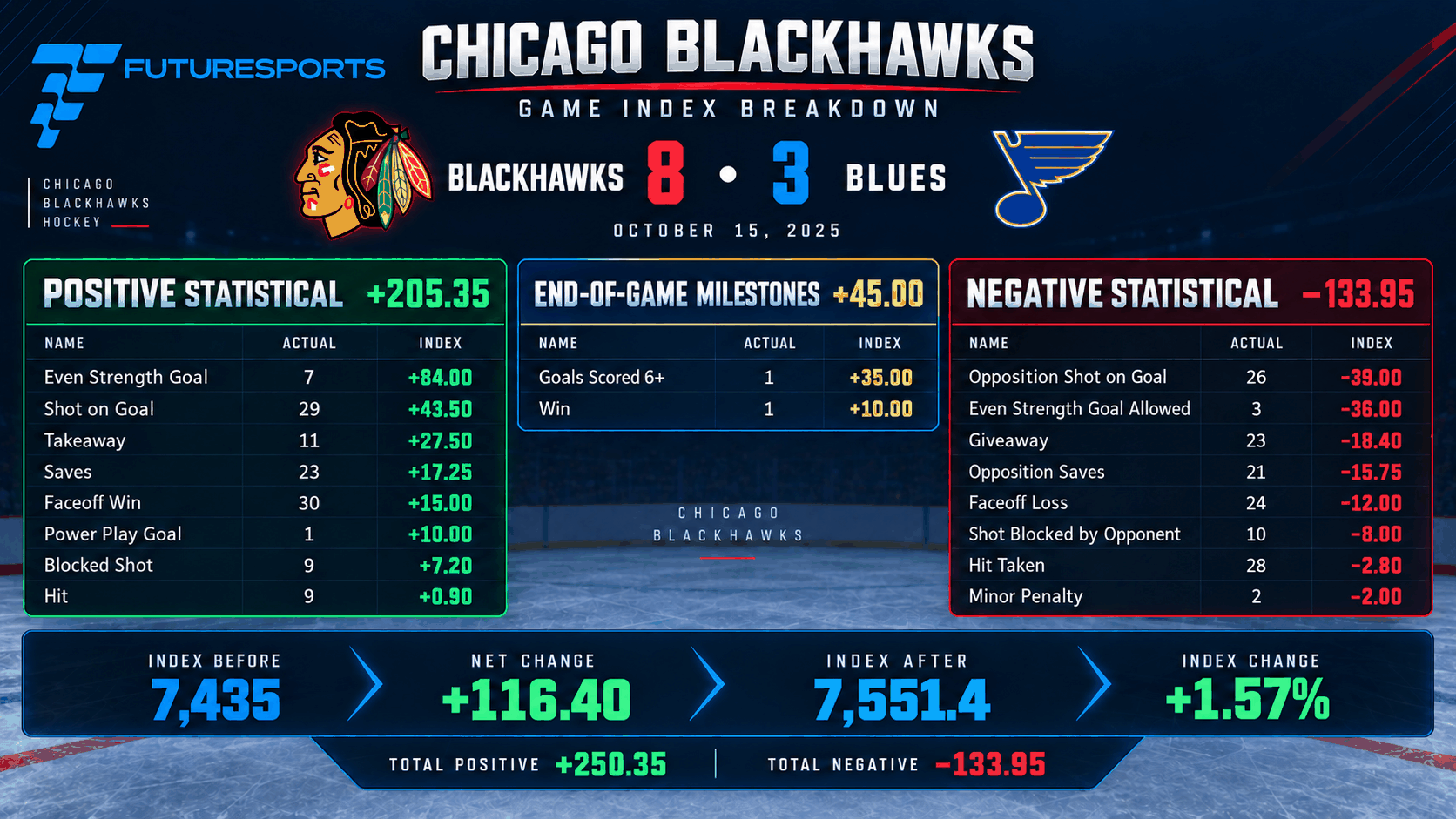
For the Blackhawks, this 8-3 win was a game of overperformance. The index reflects this, having increased 116.40 points, or 1.57%, off its pre-game index level of 7,435.00 to 7,551.40.
Chicago's overperformance came from even-strength scoring. Seven of the eight goals were scored at even strength, and those seven Even Strength Goals were the single biggest contributor at +84.00. That volume triggered the game's largest bonus, the Goals Scored 6+ milestone, worth another 35.00 points. On the other side of the score sheet, Chicago's defensive-zone play lagged behind its offense: Opposition Shot on Goal (26 against) was the largest negative factor at −39.00, compounded by 23 Giveaways (−18.40) and three Even Strength Goals Allowed (−36.00).
Netting the positive and negative constituents, the Blackhawks won by outscoring the Blues while their defensive numbers still counted against them, a distinction FSPI captures and the final score does not. The remaining gain came from the win itself, Chicago's own shots on goal, the power-play goal, saves, faceoffs, hits, blocks, and takeaways.
One good night moves the index. It does not decide it. It is not a binary outcome. It moves around a level that reflects overall performance. The index has no floor or ceiling. Sustained strong play lifts it well above the base level, and sustained poor play can take it below the base or even below zero. A good game pushes it up; a bad game pulls it down. Over time, it tells you whether a team is trending up, down, or holding steady.
Every index starts at a base value of 7,500 and resets to that level in the offseason, 32 calendar days after the last game of the Stanley Cup Final, so a pre-game level of 7,435.00 shows a team that had slipped below its starting point through a 1-2-1 opening, and 7,551.40 shows one win lifting it back above base.
What Drives the Movement?
The NHL team indexes use 55 constituents, a comprehensive set of official statistics and milestones capturing in-game, monthly, and seasonal performance. For an NHL team index:
- Statistical Performance (30 constituents): goals by type, shots on goal, saves, faceoffs, blocks, hits, takeaways and giveaways, penalties, and game outcomes such as a win, a shutout, or a game-clinching goal
- End of Game Scaled Milestones (8 constituents): goals scored scale, goals allowed scale, save % scale
- Monthly and Seasonal Milestones (15 constituents): monthly leaders/laggards, regular-season totals, conference standings, Stanley Cup winner
- Seasonal Adjustment Factors (2 constituents): 1.0 for regular-season games and 1.5 for playoff games, so every in-game constituent is worth 50 percent more in the postseason. The Stanley Cup Winner milestone of 750 points becomes 1,125 points once the 1.5 factor is applied
Each constituent gets a multiplier based on how much it contributes to overall team performance, determined by FutureSports' rules-based methodology and applied to official league data.
Real-Time Updates
Using official real-time NHL statistics provided under FutureSports' agreement with the league, index values update as plays happen. Between games, the index carries its cumulative level forward. Monthly and seasonal milestones are applied between games on a next-day basis, and the official Index Close for each calculation day is published at 9:00 AM Central Time on the following calculation day.
This is what the futures contracts reference. If you think a team is about to go on a hot streak, you can take a position in the futures before the game and watch the index respond to what actually happens.
Be sure to follow us on LinkedIn for the latest updates.
FutureSports: The index infrastructure for Sports as an Asset Class.
Futures trading involves significant risk of loss and is not suitable for all investors, and losses can exceed the funds initially deposited. Anyone considering a futures position should read the risk disclosure statement provided by their futures broker. The indexes are not investable, and past index levels are not indicative of future index levels. Futures that reference the indexes are listed by CME Group and are separate from the indexes. FutureSports is not a broker, futures commission merchant, or exchange and does not provide investment advice. The NHL does not sponsor, endorse, or administer the Indexes.
FutureSports Performance Indexes (“FSPI”) licenses CME to use various NHL Hockey Team Financial Indices (CME FSPI NHL Team Indices) in connection with the trading of futures contracts and options on futures contracts based upon such indices. FSPI and NHL (the source of the data on which the indices are calculated) shall have no liability for any damages, claims, losses or expenses caused by any errors or delays in calculating or disseminating the source data or the FSPI NHL Team Indices. FSPI, the NHL, and their respective affiliates do not guarantee the accuracy and/or completeness of the CME FSPI NHL Team Indices or any data included therein. FSPI and NHL make no warranty, express or implied, as to the results to be obtained by any person or any entity from the use of the CME FSPI NHL Team Indices or any data included therein in connection with the trading of futures contracts, options on futures contracts or any other financial product or use based on or referencing futures contracts or the indices. FSPI and NHL make no express or implied warranties, and expressly disclaims all warranties of merchantability or fitness for a particular purpose or use with respect to CME FSPI NHL Team Indices or any data included therein. Without limiting any of the foregoing, in no event shall FSPI or NHL have any liability for any special, punitive, indirect, or consequential damages (including lost profits), even if notified of the possibility of such damages. NHL is not the sponsor or creator of futures contracts or options on futures contracts, other financial products, or CME FSPI NHL Team Indices on which they are based.